
Most MLOps vendors shout about end-to-end automation, but the marketing rarely matches what the platform actually does. That gap makes picking the wrong tool an expensive mistake. Here are the top MLOps platforms right now, what each one actually does, and who each one is built for.
1. Zylo Technologies — Custom MLOps Implementation
Zylo Technologies is a custom AI and software engineering partner that designs and ships MLOps infrastructure as a project engagement, not a SaaS subscription. Where every other option on this list hands you a platform and a login, Zylo's MLOps services build the actual system your team will own and operate long after the engagement ends.
The delivery model is what sets it apart. Zylo runs senior-only pods, no junior staff in the loop, with a guaranteed six-week production cycle. That timeline is not a sales claim. It comes from 140+ systems shipped across fintech, healthcare, mobility, and enterprise, with a median 12-month ROI of approximately 3.4x on delivered roadmaps.
On the infrastructure side, Zylo works across AWS SageMaker, Azure ML, and cloud-agnostic tools including MLflow, Kubeflow, and Airflow. Your team is not locked into a single cloud vendor's pricing model. The model, the data, and the code stay with you.
This matters most when your ML system touches proprietary data or a regulated environment. A generic SaaS platform trained on public assumptions won't give you a compliance-ready audit trail or a governance layer designed around your actual access controls. Zylo builds those in from the start.
The honest caveat: Zylo is a services partner, not a self-serve product. If your team wants a dashboard login tomorrow and a sandbox to explore, this is not the starting point. But if you need production ML infrastructure that compounds over time rather than decays, this is where to start.
Teams evaluating MLOps for the first time often underestimate how much integration work sits between a notebook and a production pipeline. Zylo's scoped delivery model closes that gap without the coordination overhead of large consulting firms. For a broader view of how Zylo approaches enterprise MLOps services, the comparison there maps delivery model against governance depth across six options.
2. MLflow — The De Facto Standard for Experiment Tracking
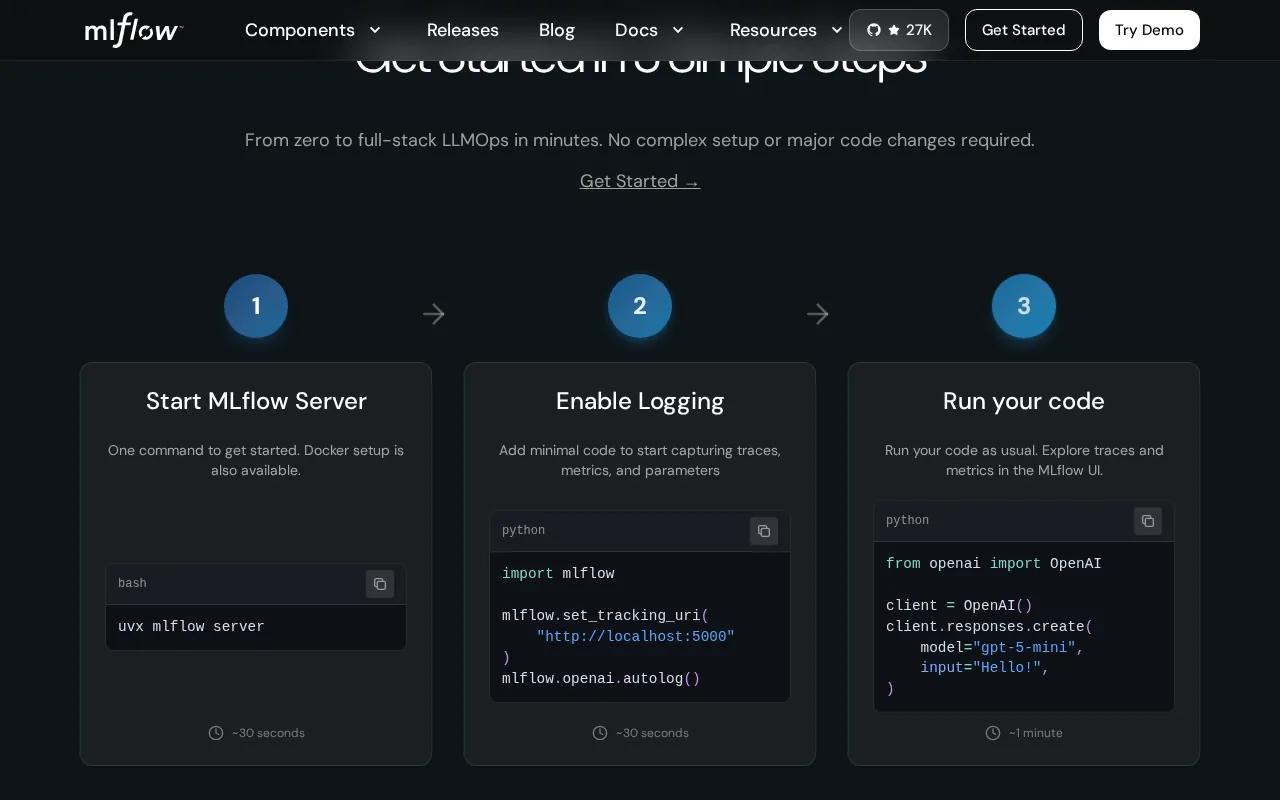
MLflow is the open-source platform most data science teams reach for first. It handles experiment tracking, model packaging, a model registry, and basic deployment. If you ask ten MLOps engineers which tool to learn first, the answer is almost always MLflow.
Originally built at Databricks, MLflow now runs as an independent open-source project with broad adoption. MLflow documents four core functions: tracking, projects, models, and the model registry. Each run is uniquely identified, artifacts are versioned automatically on logging, and the Model Registry lets teams manage staging and production transitions with a clear lineage trail.
MLflow 3 added production-ready GenAI features, and the 3.10 release introduced multi-workspace support, so teams can separate dev, staging, and production tracking inside a single deployment without messy shared experiment namespaces.
The usable limitation is orchestration. MLflow does not schedule or run multi-step workflows on its own. If you need a training job to automatically trigger validation and then deployment, you will pair MLflow with a separate orchestrator like Apache Airflow or Prefect. That pairing is common and well-documented, but it adds operational surface area.
At scale, the UI shows its age. Thousands of runs across many teams will push you toward a managed backend or a commercial alternative. For cost-conscious teams starting out, though, it is the safest and most portable bet in the space. Free and open source, with managed versions available via Databricks.
Key Takeaway
MLflow is the right starting point for teams that want open-source freedom and a structured model registry without paying for a managed platform.
3. Kubeflow — End-to-End MLOps on Kubernetes
Kubeflow is the complete ML platform for organizations that have standardized on Kubernetes. It handles training, hyperparameter tuning, pipelines, and model serving through KServe, all running natively on K8s. Its enterprise adoption and Kubernetes-native design make it a durable choice for mid-to-large engineering organizations.
The pipeline component lets teams define multi-step workflows as directed acyclic graphs and automate their execution in containerized environments. Kubernetes handles scheduling and scaling. Kubeflow 1.11 added a Model Catalog that lets teams define validated, approved models for discovery and sharing across the organization, which functions as a governed model marketplace inside your cluster.
Kubeflow also excels at distributed training. Operators for TensorFlow and PyTorch let it parallelize training jobs at a scale that most other open-source tools can't match without significant custom work.
The honest trade-off is steep. You need real Kubernetes skills on the team. Operating Kubeflow in production is not a side-of-desk task, and the learning curve is significant enough that many teams deploy only Kubeflow Pipelines rather than the full platform umbrella. That selective adoption is itself a signal about the platform's complexity.
Best for teams already running Kubernetes infrastructure who want a single platform for the full ML lifecycle. If your organization doesn't have dedicated Kubernetes ops capacity, the operational overhead will outpace the value. For teams in that position, pairing a lighter orchestration layer with MLflow often delivers faster results.
4. Weights & Biases — Managed Experiment Tracking at Scale
Weights & Biases (W&B) is the leading managed platform for ML experiment tracking and visualization. When practitioners get to pick their own tool, W&B wins more often than not. The developer experience is the best in the category.
The platform covers the full ML lifecycle: experiment tracking, model registry, artifact management, hyperparameter sweeps, and fine-tuning. The Weave layer adds LLM tracing and structured evaluation, so teams shipping both classifiers and LLM agents can manage both from a single project view. W&B also now includes LLM evaluation and prompt tracking, which matters for teams working with generative models alongside traditional ML.
W&B supports text, code, images, and audio on the same platform. Research-heavy organizations and academic labs find it particularly well-suited because the visualization tooling makes comparing runs and debugging model behavior faster than any open-source alternative.
The pricing model requires attention. W&B is free for individuals and academics, with Pro starting at $60 per month. But Weave data ingestion, storage, and inference are billed separately, which makes costs harder to predict at scale. Enterprise pricing is custom. Teams running evaluations across engineering, product, and review workflows should model total cost carefully before committing.
W&B is a SaaS product. Self-hosting is possible but operationally heavier than running MLflow. For teams that value developer experience and are willing to pay for it, it is the strongest managed option. For teams that need evaluation to control release decisions rather than just monitor experiments, a dedicated evaluation platform may be a better complement.
5. BentoML & Seldon Core — Model Serving and Deployment
Once a model is trained and tracked, it needs to serve predictions reliably in production. BentoML and Seldon Core solve that problem from two different angles, and many teams use both.
BentoML
BentoML is a Python framework for packaging ML models into deployable services. The core idea is simple: implement a class, and BentoML handles serialization, dependencies, and the HTTP service around the model. Any Python framework works, and the built-in support for PyTorch, TensorFlow, and other common frameworks handles the standard cases with minimal code.
Deployment targets include Docker, Kubernetes, serverless functions, and local hardware. That flexibility makes BentoML the right choice for teams that need to ship model APIs quickly without becoming serving infrastructure experts. BentoCloud is the paid managed deployment layer for teams that want a hosted option.
The ecosystem is newer than Seldon Core, though it has grown significantly. Teams with complex inference graph requirements may find BentoML's model-centric approach less flexible than Seldon's graph abstraction.
Seldon Core
Seldon Core is specialized for model deployment and serving on Kubernetes. It serves models via REST and gRPC, and its inference graph abstraction supports A/B testing, canary deployments, multi-armed bandit routing, and request logging out of the box. For teams running more than 100 concurrent requests, Seldon Core's architecture is designed for that load.
The inference graph is the real differentiator. A ROUTER component can dynamically decide which model in a deployment receives a given request. A COMBINER builds model ensembles directly inside the deployment. These capabilities go well beyond what BentoML offers for complex serving patterns.
The caveat: when using certain inference servers with Seldon Core, preprocessing transformations are not possible due to a known limitation. Teams that need pre- and post-processing in the serving layer need to account for that constraint in their architecture.
Kubernetes-native serving tools like Seldon Core and KServe have become the dominant pattern for production ML serving in organizations running containerized infrastructure. BentoML-packaged models can also be deployed directly onto Seldon Core or KServe, making the two tools complementary rather than competing for teams that want BentoML's packaging simplicity with Seldon's serving power.
Pro Tip
If your serving requirements include A/B testing or multi-model routing, start with Seldon Core. If you need fast packaging and multi-cloud flexibility, start with BentoML. The two integrate cleanly.
MLOps Platform Comparison Table
The research behind this comparison found that only 41% of MLOps platforms disclose their deployment model, and fewer than half name specific integrations. The table below focuses on the decision criteria that actually matter: what the platform does well, where it runs, and where it breaks down.
One pattern that stands out across the data: open-source tools tend to be more transparent about automation steps and deployment targets, while many SaaS platforms hide those specifics behind "managed infrastructure" labels. When evaluating any tool not on this list, ask the vendor to name three specific automation capabilities and the exact deployment environment. If they can't answer concisely, that tells you something. Teams looking at broader AI development company options should apply the same scrutiny: architecture diagrams over slide decks, references over testimonials.
| Platform | Primary Strength | Deployment Model | Best For | Key Limitation |
|---|---|---|---|---|
| Zylo Technologies | Custom MLOps architecture, full ownership | Project-based, cloud-agnostic | Enterprises needing production-ready systems fast | Services partner, not self-serve SaaS |
| MLflow | Experiment tracking, model registry | Self-hosted or Databricks managed | Teams starting MLOps, cost-conscious orgs | No native pipeline orchestration |
| Kubeflow | End-to-end pipelines on Kubernetes | Kubernetes, on-premise, cloud | Mid-to-large orgs already on K8s | Steep learning curve, requires K8s ops skills |
| Weights & Biases | Experiment tracking, LLM evaluation | Managed SaaS, private cloud option | Research teams, 5+ person ML orgs | Unpredictable pricing at scale |
| BentoML | Model packaging, multi-cloud deployment | Docker, K8s, serverless, local | Teams shipping model APIs quickly | Newer ecosystem, fewer advanced serving patterns |
| Seldon Core | A/B testing, inference graphs, canary deploys | Kubernetes | High-throughput serving, 100+ concurrent requests | Preprocessing limitations when using external inference servers |
How to Choose the Right MLOps Platform for Your Team

The number of features a platform lists is not what matters most. What matters is whether it can handle your actual constraints: team size, infrastructure environment, governance requirements, and how many models you're running in production right now.
Start with one question: how many distinct problem areas apply to your team?
- Experiment tracking and reproducibility are broken or missing
- Model deployment is manual, slow, or inconsistent across environments
- Multiple teams need to share features, models, or pipelines under consistent standards
- GPU resources, access controls, and audit logs need to be managed together
- The cost of integrating and maintaining separate tools is growing faster than the value they deliver
If one area applies, start with a targeted tool. MLflow for tracking, BentoML for serving. Don't adopt a full platform when a focused tool closes the gap faster.
If two or three areas apply, evaluate an integrated platform that connects the workflow. Kubeflow is the right answer if you're already on Kubernetes. W&B works well if your primary need is experiment discipline across a growing research team. At this stage, also check whether the platform can scale to support access control and resource management as the number of teams and models grows, not just what it handles today.
If four or five areas apply, you've moved past MLOps tooling into what some practitioners call an AI OS problem: managing data, models, applications, GPUs, permissions, and audit logs on a shared operational foundation. Adding more tools at that stage rarely solves the underlying problem. A delivery partner that architects the full system is often faster and more durable than self-assembling a stack from five different vendors.
Two other constraints should filter your shortlist early. First, cloud commitment: if your data already lives in a specific cloud, a platform native to that environment (SageMaker for AWS, or the provider's native platform for other clouds) reduces integration work significantly. Second, team seniority: platforms like Kubeflow and Seldon Core reward teams with dedicated infrastructure engineers. Without that capacity, the operational overhead outpaces the value. For teams in that position, a partner-led implementation through a firm like Zylo Technologies closes the gap faster than self-service onboarding ever will.
For teams thinking through how AI systems scale once they're in production, the guide on scaling AI systems without breaking them covers the instrumentation, feedback loops, and circuit-breaker patterns that keep ML infrastructure stable under load. That operational layer is what separates a model that works in a demo from one that holds up at production volume.
Frequently Asked Questions
What is the difference between MLflow and Kubeflow?
MLflow focuses on experiment tracking and model registry. It does not schedule or run multi-step pipelines on its own. Kubeflow is a full Kubernetes-native platform that orchestrates training, hyperparameter tuning, and serving as automated pipeline workflows. Most teams use MLflow for tracking inside a broader pipeline orchestrated by Kubeflow, Airflow, or a similar tool. They solve different problems and are often deployed together.
Do I need a managed MLOps platform or a custom implementation?
Managed platforms work well when your workflows are standard and your data lives in common formats. Custom implementation is the right call when your process involves proprietary data, a regulated environment, or integration with legacy systems that generic platforms handle poorly. If the AI needs to reason over data competitors don't have access to, a custom build gives you a durable advantage that a SaaS subscription can't replicate.
How much does an MLOps platform cost?
Open-source tools like MLflow, Kubeflow, BentoML, and Seldon Core are free, but infrastructure and engineering time add real cost. Weights & Biases Pro starts at $60 per month, with additional usage-based charges for data ingestion and storage. Enterprise plans across all managed platforms are custom-priced. Custom implementation through a partner like Zylo Technologies is project-based; pricing depends on scope and timeline.
What MLOps tools work best for LLM applications?
Weights & Biases added LLM tracing and prompt tracking through its Weave layer, making it a natural fit for teams already using W&B for traditional ML who want to add LLM evaluation. MLflow 3 also added production-ready GenAI features. For teams where evaluation needs to gate release decisions, a dedicated evaluation platform alongside your core MLOps stack is worth evaluating separately from experiment tracking.
Is Kubeflow hard to set up?
Yes. Kubeflow requires real Kubernetes operations skills. The learning curve is steep enough that many organizations deploy only Kubeflow Pipelines rather than the full platform. If your team doesn't have dedicated K8s engineering capacity, the setup and ongoing operational overhead often outweigh the benefits. A lighter orchestration tool paired with MLflow is a faster path for most teams without a dedicated platform engineering function.
How do I know if my team is ready for MLOps tooling?
The signal is usually pain, not maturity. If reproducing a model result takes more than a day, if deploying a new model version requires manual steps that break under time pressure, or if multiple teams are running experiments without shared visibility, you need MLOps tooling now. Start with experiment tracking and a model registry. Add pipeline orchestration and serving infrastructure once those foundations are stable.
Conclusion
For most teams, the right starting point is MLflow for tracking and BentoML or Seldon Core for serving, with Kubeflow added once Kubernetes infrastructure is already in place. For teams that need production ML systems fast, with full data ownership and a fixed delivery timeline, Zylo Technologies is the right partner. The enterprise AI workflow automation guide is a useful next step for understanding how ML systems connect to the broader operational stack they're meant to serve.
Share this article
Author information coming soon.